

Did you know that oral rehabilitation is a dental specialisation? We all know how important teeth are to humans. They allow us to chew food, thus helping the digestive system for better digestion. Together with the tongue, they also aid in pronunciation. Without neglecting other factors, these are more than enough reasons to keep them healthy throughout our lives.
When we neglect proper dental care, certain diseases can lead to the loss of some teeth if not treated promptly, which will result in functional and aesthetic problems.
It is precisely to solve this problem that the dental specialty known as oral rehabilitation exists. Its purpose is to restore the dentition, recover its functionality, health and aesthetics using dentures fixed or removable.
This specialty covers everything from diagnosis to the treatment plan and rehabilitation. Its objective is the preservation of oral functions – such as chewing and speech articulation – through modern, high-tech procedures (combined with other disciplines such as periodontics, endodontics, implantology, and orthodontics).
Certainly, not all patients require oral rehabilitation, but there are specific characteristics that indicate to the dentist which people are in need of this specialist work. Below we list some of these characteristics:
– Root canal treatment (endodontics): People undergoing this type of treatment are candidates for oral rehabilitation to adequately rebuild the affected tooth.
– Fractured teeth: In some situations, the trauma caused by bruising or bruxism is so severe that direct restoration of the tooth becomes impossible. In these cases, the patient is advised to undergo oral rehabilitation treatment to restore the function of the teeth.
Lost teeth: As you know, teeth can be lost due to trauma and gum infections. When this happens, there are different ways to restore aesthetics, harmony, and functionality through oral rehabilitation treatments such as the placement of implants, fixed or removable prostheses.
Types of prostheses
Dental prostheses are artificial devices used to restore the anatomy of one or more teeth. Their aim is to recover oral functions such as effective chewing and phonetics. Do not neglect the fact that your dental prosthesis should not interfere with swallowing food, breathing, and tongue movements so that you feel comfortable when eating and communicating.
Your dentist will advise you on what type of prosthetics you will need to restore harmony and aesthetics to your mouth. Your problem may require various oral rehabilitation techniques or just one, and although you will have professional advice, you should consider aspects such as health, comfort, treatment effectiveness, or even its cost. All these factors will help in your decision.
Dental prostheses are classified into two main categories, taking into account the different characteristics of each.
Fixed dental prosthesis.
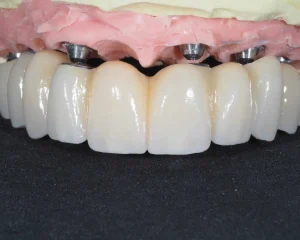
Only your dentist should place and/or remove it. It looks like a normal tooth and requires a continuation of your daily routine for its maintenance. Within this type of rehabilitation, we find: Dental bridges – used to replace one or more teeth; fixed dentures on dental implants – used in cases of people who have no teeth or who need to replace one or more teeth without damaging their natural teeth.
2. Removable dental prosthesis.
It's a type of prosthesis that you can remove yourself without necessarily having to go to your dentist, and you should clean it daily. Whether for financial reasons or for health reasons – when there isn't enough bone to place an implant – this is the most widely used solution.
You can choose between a partial denture – to replace some missing teeth in your oral cavity – or a complete denture – indicated for people who have no remaining teeth and are contraindicated for implants.
Relationship with periodontics, endodontics and implantology
The importance of oral rehabilitation serves, for the dentist, to have knowledge related to the restoration of the oral cavity and to provide harmony and aesthetics to the prosthesis.
Concerning periodontia – a disease that occurs in the gums resulting from an unhealthy dental cleaning routine – the dentist should initially treat the inflammation, redness and bleeding of the gums before proceeding with oral rehabilitation, thus ensuring proper form, function, aesthetics and comfort of the dentition.
Ensuring the correct functioning of the oral cavity for adequate chewing is one of the dentist's main objectives. In the case of endodontics, the oral rehabilitation specialist is motivated to place a removable or fixed prosthesis.
Dentist in and oral rehabilitation are closely related. The rehabilitator has a broad view of the problem, and the other specialist places the implant component. Both dentists must understand each other to achieve beneficial results for the patient.
Benefits of oral rehabilitation
The full restoration of functionality and improvements in bite, elimination of headaches, elimination of pain in the chewing muscles, among others, are many of the benefits that come from restoring teeth through oral rehabilitation.
Having dental harmony represents better aesthetics, which increases your self-esteem, leading you to smile more confidently, sure that there are no anomalies. No one will notice the false part given the similarity to natural teeth.
Although many people don't connect it, oral rehabilitation will improve your gastric process as chewing food correctly facilitates digestion.
What we provide in this article on such an important topic is intended to inform and give you general knowledge about it. No one other than your dentist, who is the indicated specialist, will know better if you need oral rehabilitation. Only they can assess your case and propose the best solution for you.