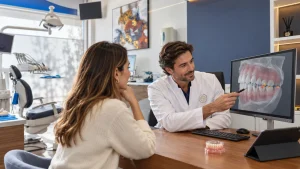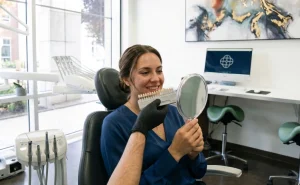


Improving your smile does not mean turning it into an artificial or exaggerated version. For many patients, the main concern is not even having whiter or straighter teeth than everyone else — it is achieving a harmonious, balanced result that suits their face.
It is precisely in this context that the dental veneers may be appropriate. Where there is a clinical indication, proper planning and careful attention to aesthetics and function, this treatment can help to improve the shape, colour and proportion of the teeth without compromising their natural appearance.
No Dental Veneers page, you can find out more about this type of treatment. Nevertheless, before making a decision, it is important to understand in which situations it may be recommended and why the final result should not depend solely on the desire to “change your smile”, but rather on a careful clinical assessment.
What are dental veneers?
Dental veneers are thin shells, usually made of porcelain or a similar material, which are placed on the visible surface of the teeth to improve aspects such as:
- dental form;
- proportion between the teeth;
- minor asymmetries;
- wear and tear;
- some colour variations;
- overall harmony of the smile.
Although many people associate this treatment solely with aesthetics, the decision should not be made on a superficial basis. Veneers need to be incorporated into a suitable treatment plan, taking into account the patient’s dental anatomy, bite, gum health and natural facial expression.
If you would like to gain a better understanding of how this type of treatment fits into the Dental Aesthetics, it’s also worth visiting the main page for this section.
What does a natural result mean?
A natural smile isn’t just a white smile. Naturalness means balance.
In practice, this means taking various factors into account:
- the shape of the face;
- the smile line;
- the proportion between the teeth;
- the relationship between the teeth, lips and gums;
- the patient’s age;
- aesthetic and functional expectations.
When these factors are taken into account, the result tends to be more subtle, elegant and consistent with the patient’s identity. The aim should not be to create an artificial or standardised smile, but rather to improve what is already there, using clinical judgement.
When might dental veneers be a good option?
Veneers may be an option to consider in selected cases, for example when the following apply:
- teeth with visible wear;
- changes in shape or minor irregularities;
- slight gaps between the teeth;
- some blemishes or discolouration that do not respond as desired to other treatments;
- the need to improve the harmony of one’s smile without resorting to inappropriate solutions.
However, not all cases should be treated with veneers. In some situations, the best approach may involve another type of treatment, such as Teeth whitening, orthodontics, rehabilitation or a planned combination of solutions.
Therefore, the choice should not be made solely on the basis of photographs or general recommendations. It should always be based on an individual assessment.
Not everything that appears aesthetically pleasing should be treated in the same way
This is one of the most important points. Two patients might say that they “don’t like their smile”, but the real problem may be something completely different.
In one case, the main issue may simply be the colour of the teeth. In another, there may be wear, misalignment, fractures, asymmetries or functional abnormalities that require a different approach to clinical reasoning.
This is precisely why a premium cosmetic treatment should not be reduced to a quick fix or a one-size-fits-all solution. The right decision depends on assessing each individual case, analysing the options and drawing up a coherent plan.
What should be considered before making a decision?
Before proceeding with dental veneers, it is important to assess various clinical and aesthetic factors, such as:
- the general condition of the teeth;
- gum health;
- occlusion and function;
- the level of tooth wear;
- the patient’s expectations;
- the feasibility of treatment and the available alternatives.
At the Dr Pedro Coelho Clinic, this approach to assessment is particularly important when patients are seeking aesthetic improvements with harmonious, personalised results. If you would like a more targeted and structured assessment, you can find out more about the Smile Advisor® Consultation, designed for situations where it is important to understand the starting point, the options and the most appropriate plan.
Dental veneers should not be a spur-of-the-moment decision
In dentistry, an attractive result should not compromise health, function or a natural appearance. Therefore, the decision to have veneers fitted should be carefully considered and well-founded.
Rather than asking “Do I want veneers?”, the right question is usually: What is the most appropriate approach in my case?
This difference in perspective is crucial. For some patients, veneers may be an excellent option. For others, the best outcome may lie in a different type of treatment or a phased approach.
Enhancing your smile naturally requires careful planning
When clinical criteria are in place, cosmetic treatment ceases to be merely a visual change and becomes a more informed, safer decision that is better suited to the patient’s circumstances.
If you’re looking for a more harmonious smile – one that isn’t overdone and retains its natural look – the first step should be a professional assessment. From there, it becomes clear whether dental veneers are the right option for you and what the most suitable course of action might be.
Find out more about Dental Veneers, explore the area of Dental Aesthetics, find out more about the Smile Advisor® Consultation or, if you prefer, you can book an appointment.
Dental veneers and a natural-looking smile
Can dental veneers look natural?
Yes. A natural-looking result depends on the planning, the proportions, the shape, the colour and how the teeth relate to each patient’s face and smile. The aim should not be to create a standardised smile, but to enhance harmony whilst maintaining a balanced appearance that is consistent with the person’s identity. You can find out more about the treatment on the Dental Veneers.
In what situations might dental veneers be considered?
Veneers may be considered in selected cases to improve aspects such as shape, proportion, wear, minor asymmetries or certain changes in colour. The indication always depends on the clinical situation, oral health and the objectives of each patient.
Are dental veneers suitable for all patients?
No. There are situations in which another treatment may be more appropriate. Depending on the diagnosis, it may make more sense to consider teeth whitening, orthodontics, restorative dentistry or a combination of approaches. Therefore, the decision should be made following a clinical assessment and not solely on the basis of the desired aesthetic result.
What is the difference between veneers and teeth whitening?
Teeth whitening mainly affects the colour of the teeth. Veneers, when appropriate, can also help to address shape, proportion and certain aesthetic irregularities. These are different treatments and the choice depends on the problem you wish to correct. You can find out more about these solutions in the area of Dental Aesthetics.
Does aesthetic planning influence the outcome of veneers?
Yes. Planning enables us to assess proportions, the smile, teeth, gums, function, expectations and the patient’s individual characteristics before deciding on a solution. This stage is essential for achieving a balanced, functional and visually natural result.
Is it necessary to assess your bite and oral health before having veneers fitted?
Yes. The decision should not be based solely on the appearance of the teeth. Gum health, the condition of the teeth, the bite, wear and other clinical factors may influence the indication for and planning of treatment.
How can I tell if veneers are the best option for improving my smile?
The best way to work out which solution is right for you is through a personalised assessment. When there are concerns about aesthetics, function or different treatment options, the Smile Advisor® Consultation It can help you understand where to start, the options available and the most suitable plan for your situation.
How can I book an appointment for dental veneers?
You can request an assessment via the page BOOK A CONSULTATION. The assessment enables us to analyse the clinical situation, clarify expectations and determine whether dental veneers are suitable or whether another approach is more appropriate.