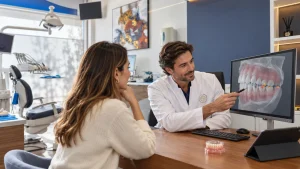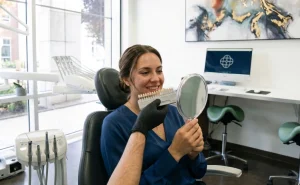

When we think about straightening our teeth, it is natural for our first concern to be the appearance of our smile. Overlapping teeth, visible gaps or minor irregularities can prompt us to seek orthodontic treatment.
However, A straighter smile begins long before you start wearing braces or clear aligners. The position of the teeth is only one part of the assessment. Gum health, the relationship between the dental arches and each patient’s individual characteristics also influence the treatment plan.
At the Dr Pedro Coelho Clinic in Oeiras, the Orthodontics It is approached on the basis of an individualised assessment, taking into account aesthetics, function and oral health.
Why does an orthodontic assessment go beyond the appearance of the teeth?
Two patients may have teeth that appear similar, yet still require different treatment plans.
A visible irregularity may be linked to the position of certain teeth, a lack of space in the dental arch, or the way in which the upper and lower teeth come into contact when biting down.
There are also situations in which the primary aesthetic concern does not, in itself, reveal all the clinical conditions that need to be taken into account.
For this reason, an orthodontic assessment seeks to understand the whole picture, rather than simply analysing the teeth that the patient would like to have straightened.
What is assessed during an orthodontic assessment?
A comprehensive assessment gathers information on oral health, the position of the teeth, the bite and the patient’s goals. The procedures and examinations required depend on the specific details of each case.
1. Condition of the teeth and oral health
Before planning tooth movement, it is important to assess the condition of the teeth.
The dentist can assess the presence of tooth decay, fillings, tooth wear and other conditions that may affect treatment.
This observation makes it possible to identify situations that require prior attention and to understand whether there are any limitations or additional precautions to be taken into account.
The decision to commence treatment must take account of the patient’s current clinical condition, and treatment should not be undertaken solely for aesthetic reasons.
2. Health of the gums and supporting tissues
Teeth do not move in isolation. They are attached to the bone and the tissues that support them, which are key structures during orthodontic treatment.
For this reason, the assessment of the gums and periodontal support is particularly important.
Signs of inflammation, gum changes or periodontal disease may require specific treatment before tooth movement can begin.
In certain situations, it may be necessary to manage periodontal disease beforehand or to put in place appropriate monitoring throughout the course of treatment.
A responsible assessment takes into account not only the desired position of the teeth, but also the biological conditions required to move them.
3. Bite and the relationship between the dental arches
The way in which the upper and lower teeth relate to one another is one of the key aspects of orthodontics.
During the examination, the dentist checks how the teeth come into contact with one another and whether there are any changes in the bite.
The situations that can be identified include:
- Crossbite, where certain teeth have an abnormal transverse relationship.
- Open bite, where there is no contact between groups of teeth that would normally come into contact.
- Deep bite, where the upper teeth overlap the lower teeth significantly in the vertical plane.
- Crowded teeth, where there is a lack of space for the teeth to align properly.
- Excessive gaps between teeth, which may require an assessment of their cause and the most appropriate method of correction.
Not all of these situations are equally complex, nor do they all require the same approach.
The aim is to understand how the position of the teeth and the relationship between the dental arches influence orthodontic planning.
What tests might be required before starting treatment?
A face-to-face clinical examination is a key part of the diagnosis, but it can be supplemented by various records.
Depending on the situation, the assessment may include clinical photographs, X-rays and digital models of the dentition.
Each resource provides different information:
- Clinical photographs: They help to document tooth alignment, the aesthetics of the smile and certain aspects of facial proportions.
- X-ray examinations: enable the observation of structures that are not visible during an external examination, where clinically indicated.
- Intraoral scanning: It enables the creation of a three-dimensional representation of dental surfaces, which is useful for the study and planning of certain treatments.
In the approach to Invisalign at Dr Pedro Coelho’s Clinic, digital records form part of the assessment and planning process for custom aligners.
However, digital technology is no substitute for a clinical examination. A scan of the teeth, for example, does not provide all the information about the health of the roots or the supporting tissues.
The choice of tests should be based on each patient’s diagnostic needs.
What happens when the assessment identifies issues that need to be addressed first?
The best time to start orthodontic treatment is not always immediately after the first consultation.
If any changes are identified that require treatment, the plan may include preparatory care to ensure good oral health.
The presence of tooth decay, gum inflammation or a periodontal condition requiring treatment does not, in itself, mean that orthodontic treatment is definitively ruled out.
This means that the course of treatment should be determined on the basis of clinical judgement.
This approach makes it possible to set priorities and explain to the patient the steps required before proceeding.
How is the type of orthodontic treatment decided?
Once the necessary information has been gathered, the dentist can discuss the treatment options and the clinically appropriate objectives.
The choice does not depend solely on aesthetic preference or the discretion of the device.
It is important to consider the nature of the misalignment, the bite, the complexity of the movements required, oral health and the level of cooperation required during treatment.
A Orthodontics in Oeiras It offers treatment options using fixed braces and clear aligners, with the appropriate treatment determined on a case-by-case basis.
Invisalign aligners may be an option in certain cases, but they should not automatically be considered the recommended solution for any misalignment.
The planning aims to integrate aesthetic objectives with the patient’s functional and clinical needs.
What should you clarify during your first appointment?
An orthodontic assessment should also be an opportunity to provide clarification.
As well as understanding the diagnosis, it is important that the patient has the opportunity to ask questions about the process.
Some key issues include:
- What is the orthodontic problem that has been identified?
- Are there any oral health conditions that need to be treated first?
- What treatment options are suitable for my situation?
- What further tests might be required?
- What is the approximate duration, and what follow-up care is planned?
- What will be needed to maintain the results after treatment?
These questions help you to better understand the possibilities, limitations and commitment involved in the treatment.
Orthodontic assessment in Oeiras: a first step towards making a confident decision
Straightening teeth can make a significant difference to how a person feels about their smile. However, an informed decision must begin with an understanding of oral health and each patient’s specific needs.
An orthodontic assessment enables us to identify the factors that influence treatment, clarify expectations and draw up a personalised treatment plan.
At the Dr Pedro Coelho Clinic in Oeiras, this approach combines a commitment to diagnosis, treatment planning and clinical follow-up.
If you’re thinking about having your teeth straightened, you can start by finding out about our approach at Orthodontics and request an assessment to understand the options best suited to your situation.
Frequently asked questions about orthodontic assessment
Is it necessary to treat gum problems before starting orthodontic treatment?
It depends on the condition identified. Where there is periodontal disease or inflammation that could compromise the safety of tooth movement, it may be necessary to carry out treatment or establish clinical monitoring before proceeding.
Do all patients need the same orthodontic examinations?
No. The tests are determined according to the clinical situation. Photographs, X-rays and digital records may provide additional information, but whether each is required depends on the diagnosis.
Do intraoral scans replace X-rays?
No. Intraoral scanning allows the surfaces of the teeth to be digitally recorded. X-rays, where indicated, provide additional information about structures not visible on the scan, such as roots and bone.
Does having teeth that look straight mean that your bite is correct?
Not necessarily. The visible alignment and the functional relationship between the teeth are two different matters. Therefore, an assessment of the bite forms part of the orthodontic diagnosis.
Is the type of braces decided at the first appointment?
The initial assessment enables us to identify needs and discuss options. The final decision may depend on further tests and the outcome of the clinical trial. You can find out about the available approaches on the Orthodontics.
Book an orthodontic consultation in Oeiras
If you want to straighten your teeth, the first step is to understand your oral health, your bite and the treatment options best suited to your situation.
At the Dr Pedro Coelho Clinic, a clinical assessment helps to clarify these issues and guide the decision-making process based on a personalised treatment plan.
Frequently asked questions about orthodontic assessment
Is it necessary to treat gum problems before starting orthodontic treatment?
It depends on the condition identified. Where there is periodontal disease or inflammation that could compromise the safety of tooth movement, it may be necessary to carry out treatment or establish clinical monitoring before proceeding.
Do all patients need the same orthodontic examinations?
No. The tests are determined according to the clinical situation. Photographs, X-rays and digital records may provide additional information, but whether each is required depends on the diagnosis.
Do intraoral scans replace X-rays?
No. Intraoral scanning allows the surfaces of the teeth to be digitally recorded. X-rays, where indicated, provide additional information about structures not visible on the scan, such as roots and bone.
Does having teeth that look straight mean that your bite is correct?
Not necessarily. The visible alignment and the functional relationship between the teeth are two different matters. Therefore, an assessment of the bite forms part of the orthodontic diagnosis.
Is the type of braces decided at the first appointment?
The initial assessment enables us to identify needs and discuss options. The final decision may depend on further tests and the outcome of the clinical trial. You can find out about the available approaches on the Orthodontics.