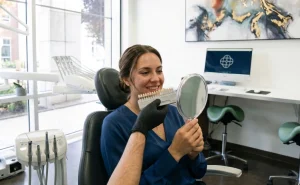


The desire to straighten one’s teeth does not end in adolescence. Many adults seek to improve their smile, the way their teeth fit together and the confidence with which they communicate, but prefer an orthodontic approach that is discreet and fits in with their daily routine.
It is in this context that Invisalign and clear aligners may be worth considering. However, the decision should not start with the treatment itself. It should begin with a clinical assessment to establish the starting point, the patient’s goals and whether this approach is suitable for the case.
At the Dr Pedro Coelho Clinic in Oeiras, Invisalign forms part of the Orthodontics and is based on a process of assessment, planning and individual support.
Why do so many adults seek a more discreet orthodontic solution?
In adulthood, the decision to start orthodontic treatment is usually linked to a combination of aesthetic, functional and personal factors.
Some people feel that misaligned teeth detract from the harmony of their smile. Others are looking for a more visually discreet alternative to traditional braces. In many cases, there is simply a desire to address an issue that has been put off over the years.
The key point is that aesthetic considerations alone do not determine the treatment. The decision must be based on clinical grounds and tailored to the individual.
Core principle: First, understand the situation; then decide whether invisible aligners are the right choice.
What sets Invisalign apart within a modern orthodontic approach?
Invisalign uses clear aligners as part of a planned orthodontic treatment. For many adults, its main advantage is that it is visually discreet and blends in more naturally with everyday life.
However, technology alone cannot replace a diagnosis. The outcome of orthodontic treatment depends on a correct assessment, a treatment plan tailored to the individual case, and clinical monitoring throughout the process.
That is why the page Invisalign in Oeiras It should be understood as the presentation of a treatment option within an orthodontic plan, and not as an automatic solution for anyone wishing to straighten their teeth.
When might it be worth considering invisible aligners as an adult?
It makes sense to seek a consultation if you are keen to improve the alignment of your teeth whilst, at the same time, preferring a discreet approach.
This assessment is particularly important for understanding:
- what is the current condition of the teeth;
- how healthy your gums are;
- how the teeth fit together when biting;
- what the patient’s aesthetic and functional goals are;
- whether the aligners are suitable for the case;
- what sort of planning and monitoring will be required.
It is not the patient who should arrive at the appointment having already decided on a course of treatment. The aim of the appointment is precisely to turn an intention — “I want to straighten my teeth” — into an informed clinical decision.
Adulthood, in itself, should not be the deciding factor
The fact that a person is an adult does not, in itself, determine whether or not they can undergo treatment with aligners.
What matters is the clinical condition, the oral health, the bite, the objectives and the feasibility of the proposed treatment plan. For this reason, two people with similar aesthetic concerns may require different approaches.
This is one of the reasons why an orthodontic assessment is more valuable than choosing a treatment based solely on the appearance of the braces or the popularity of the technology.
Straightening your teeth isn’t just a cosmetic decision
A straighter smile may have a significant aesthetic aspect, but orthodontics should not be reduced to that alone.
The position of the teeth, the way they contact one another and the occlusal relationship are all part of the clinical assessment. Therefore, even when the initial motivation is to improve the smile, the treatment plan must take the whole picture into account.
This approach helps to ensure that the decision remains focused on oral health, function and aesthetics in a balanced way.
Why is it important to assess your teeth, gums and bite before proceeding?
Aligners operate within a biological and functional context. Before starting treatment, it is necessary to confirm that the clinical situation allows the treatment to proceed safely and that the treatment plan addresses the patient’s actual problem.
The assessment helps to identify whether there are any factors that need to be taken into account before or during treatment, and prevents an orthodontic solution from becoming a purely commercial decision.
This is also where the pillar page for Orthodontics plays an important role: placing Invisalign within a broader clinical context, including diagnosis and follow-up.
Invisalign in Oeiras: the first step is to find out whether it’s right for you
If you’re looking for a discreet solution to straighten your teeth, the best first step isn’t to choose a type of aligner. It’s to find out whether the treatment is suitable for you and what goals can be set in a responsible way.
At the Dr Pedro Coelho Clinic, the assessment enables us to analyse the clinical situation and discuss the options before proceeding.
You can find out about the approach taken by Invisalign Or book an assessment appointment to work out which course of action is right for you.
Frequently asked questions about Invisalign for adults
Is Invisalign suitable for all adults?
No. The recommendation depends on the clinical assessment, the position of the teeth, the bite, oral health and the patient’s goals. The first step should be an assessment at Orthodontics.
Can I choose aligners simply because they’re more discreet?
Discretion may be an important advantage, but it should not be the only criterion. You need to check whether the aligners are clinically suitable for your case.
Do you need to have your bite assessed before using aligners?
Yes. The bite is part of the orthodontic assessment and should be considered alongside the teeth, the gums and the treatment objectives.
Is Invisalign only used to improve the appearance of a smile?
It should not be viewed merely as an aesthetic solution. Orthodontic planning also takes into account the relationship between the teeth and their function, based on an individual assessment.
How do I know if Invisalign is right for me?
The correct approach is to carry out a clinical assessment. You can find out more on the Invisalign and, if you wish to proceed, book an appointment to discuss your case.
Would you like to find out whether Invisalign is right for you?
A clinical assessment helps you understand your starting point, your goals and whether clear aligners are a suitable option for you.