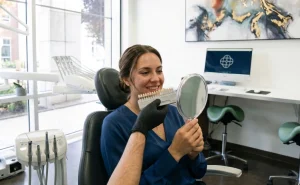


Losing teeth is a situation that, unfortunately, affects many people throughout their lives. Whether due to cavities, gum disease, accidents, or natural wear and tear, the absence of one or more teeth can have a profound impact on both the aesthetics and function of the mouth.
The good news is that dentistry today offers effective solutions to restore confidence and well-being. Among these, dental prosthetics stand out, a treatment that allows you to regain your smile and improve your quality of life. In this article, we explain everything you need to know.
Uma prótese dentária é um dispositivo médico, geralmente feito de acrílico ou porcelana, que substitui um ou mais dentes em falta. Serve para restaurar a função de mastigação, melhorar a fala e a estética facial, e prevenir a perda de dentes vizinhos.
A dental prosthesis is a custom-made device that replaces missing teeth, restoring the ability to chew, speak, and smile naturally.
There are several situations in which this treatment is indicated: after the loss of one or more teeth, in cases of pronounced tooth wear, or in situations where a natural tooth can no longer be restored.
As well as restoring aesthetics, a prosthesis helps to prevent problems such as the displacement of neighbouring teeth or changes in bite and facial shape.
Fixed or removable dental prosthesis: what are the differences?
When considering a prosthesis, it's natural to have questions about the different types available. The choice between a fixed or removable dental prosthesis depends on several factors, such as the condition of the mouth, the number of missing teeth, and the patient's preferences.
Fixed dental prosthesis
This type of prosthesis is fitted permanently, being fixed onto prepared natural teeth or dental implants. Therefore, it offers great stability and comfort.
Fixed prostheses include crowns, bridges, and total implant-supported rehabilitations, an increasingly popular solution. The sensation when chewing and speaking is very close to that of natural teeth, and the aesthetics are extremely natural.
Removable dental prosthesis
On the other hand, a removable prosthesis (also known as a denture, in the case of replacing all teeth) can be removed by the patient for cleaning and rest.
It is a more affordable option and indicated in cases of extensive tooth loss or when implants cannot be placed. There are removable partial dentures, which replace only a few teeth, and complete dentures.
Nowadays, removable dentures on implants are also increasingly used, combining implant stability with removable denture versatility.
How is the process of fitting a dental prosthesis carried out?
The process always begins with a detailed assessment. The dentist analyses the condition of the mouth, gum health, and available bone, in order to recommend the most suitable solution.
Then, personalised planning is carried out. The prosthesis is designed and custom-made to perfectly fit each patient's mouth.
The fitting stage includes several steps, from the trial to the final adjustments. It is important to allow time for a good adaptation, especially in the first few weeks. Throughout this period, the dentist's monitoring is essential to ensure maximum comfort and functionality.
Dental prosthesis care and maintenance
A well-maintained prosthesis can last for many years. The secret lies in daily care and regular visits to the dentist.
If you opt for a removable denture, you should remove it daily to clean it with a soft brush and specific products. It is also advisable to leave it out of your mouth overnight, unless medically indicated.
In the case of fixed prostheses, care is similar to what you would have with natural teeth: careful brushing, flossing (or interdental brushes, if recommended), and regular check-ups for professional monitoring and cleaning.
Regardless of the type of prosthesis, maintaining good oral hygiene and following your dentist's recommendations is essential for prolonging the durability of the treatment and protecting your oral health.
Advantages of a dental prosthesis
Choosing a dental prosthesis has numerous benefits. Firstly, it restores the ability to chew and speak comfortably, which has a significant impact on eating and daily well-being.
Aesthetically, it allows for the restoration of a beautiful, natural smile, which enhances self-confidence. Furthermore, it prevents remaining teeth from shifting and contributes to the preservation of the face's bone structure.
Each case is unique, but clinical experience shows that patients who proceed with this type of treatment are generally very satisfied with the results.
Are you considering getting a dental prosthesis?
A decisão de avançar para uma denture it is an important step and should always be well considered, with the guidance of a trusted dentist.
Every mouth is different, and there's no “one-size-fits-all” solution. That's why a detailed diagnosis and a personalised treatment plan are essential to ensure the prosthesis meets your expectations and needs.
If you are considering taking this step, or if you are still unsure about the best option for you, book a consultation. Our team will be happy to answer your questions and guide you through the process.
Frequently asked questions about dental prostheses
Does getting a dental prosthesis hurt?
No. The entire process is performed with local anaesthetic, and the adaptation occurs gradually and in a controlled manner.
How long does a prosthetic last?
With the proper care, a dental prosthesis can last for many years. Naturally, over time, minor adjustments may be necessary.
Do removable dentures come loose easily?
A well-fitting prosthesis should not come loose. In the case of removable dentures on implants, the stability is even greater.
A principal diferença entre uma dentadura e uma prótese fixa reside na sua mobilidade e na forma como são fixadas na boca. Uma **dentadura** (também conhecida como prótese removível completa ou parcial) é uma estrutura com dentes artificiais que pode ser removida pelo utilizador para limpeza e durante o sono. As dentaduras são suportadas pelas gengivas e pelo osso subjacente, e a sua estabilidade depende de uma boa adaptação à gengiva e, por vezes, de adesivos dentários. Uma **prótese fixa** (também conhecida como coroa ou ponte fixa) é cimentada permanentemente sobre dentes naturais (se estes estiverem em bom estado para servirem de suporte) ou sobre implantes dentários. Ao contrário das dentaduras, as próteses fixas não podem ser removidas pelo utilizador e funcionam e parecem-se mais com dentes naturais.
Dentures are a removable full prosthesis, while fixed prostheses are a permanent solution, offering greater comfort and stability.