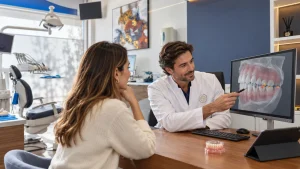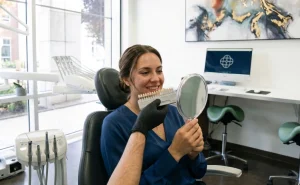


Invisalign is a system designed by the company Align Technology, and it consists of a combination of patented virtual software with rapid manufacturing processes, and highly customised, transparent, and removable appliances.
Dental aesthetics have been gaining significant importance in the field of Dentistry as technological advancements mean that most treatments can become more tolerable for patients and do not affect their appearance.
Nowadays, people care a great deal about their appearance, so an orthodontic treatment that is noticeable is sometimes not the first choice. However, the innovative Invisalign System is now available on the market, which allows treatment to be carried out more discreetly.
What is the Invisalign System?
It's an innovative and cutting-edge orthodontic technique, created to correct the position of teeth in order to improve oral health, in a completely discreet way. It's an excellent alternative, allowing you to improve your smile without others noticing.
It's a technique that gains more followers with each passing day, as it contributes to aesthetics during treatment, with the placement of aligners designed to improve tooth position.
It is important to take into account that invisible orthodontics can only be practised by a professional who is certified in this technique, as it differs from the placement of traditional metal braces, this approach being patented and exclusive to doctors with this type of training.
Your computerised system makes the professional's job easier and improves the patient's perception of the final treatment, as the entire process is monitored virtually. It is a highly effective treatment recommended for correcting practically all types of dental alignment issues or problematic bite types.
Invisalign is a system that uses a series of clear aligners, custom-made for your teeth, to gradually straighten them. It's a discreet alternative to traditional metal braces. Here's a general outline of the Invisalign procedure: 1. **Consultation with an Invisalign Provider:** * You'll start by visiting an orthodontist or dentist who is certified to provide Invisalign treatment. * They will examine your teeth and bite, discuss your smile goals, and determine if Invisalign is the right option for you. * They will take digital scans (or impressions) of your teeth, X-rays, and photos. 2. **Treatment Planning:** * Using the digital scans, the Invisalign provider will create a precise 3D treatment plan. * This plan shows the step-by-step movement of your teeth, outlining how each aligner will gently shift them into their correct positions. * You'll often have the opportunity to view a simulation of your predicted smile outcome before treatment begins. 3. **Receiving Your Aligners:** * Once the treatment plan is approved, your custom-made clear aligners will be fabricated. * When they're ready, you’ll return to your provider to receive your first set of aligners. * They will ensure they fit correctly and explain how to wear and care for them. 4. **Wearing and Changing Aligners:** * You'll wear each set of aligners for approximately one to two weeks (as instructed by your provider). * Aligners should be worn for 20-22 hours a day, only removing them to eat, drink (non-coloured liquids are generally okay), and brush/floss your teeth. * As you progress through the series of aligners, your teeth will gradually move into their desired positions. 5. **Regular Check-ups:** * You'll have periodic appointments with your Invisalign provider (typically every 6-8 weeks) to monitor your progress. * During these visits, they will check how your teeth are moving and provide you with your next set of aligners. 6. **Completion of Treatment:** * Once you've worn the final aligner in the series, your teeth will have reached their final corrected positions. * Your provider will assess the results. 7. **Retention:** * To maintain your straightened smile, you will usually need to wear retainers. * These can be clear plastic aligners (like Vivera retainers) that you wear at night, or fixed wires bonded to the back of your teeth. * The type and duration of retainer wear will be determined by your provider. The exact procedure and timeline can vary slightly depending on the complexity of your case and the specific recommendations of your Invisalign provider.
Once the dentist decides that orthodontics are necessary, a process distinct from the usual begins.
During the first consultation, the person's expectations regarding how they want their smile to look are assessed, so that the professional obtains the information they will work with in the future, alongside functional needs.
Subsequently, diagnostic examinations are carried out, followed by impressions to obtain a record of the teeth's positioning.
With the correct software, it is possible to create a 3D model that will simulate the movements necessary to achieve the desired results.
The impressions are sent for the manufacture of the aligners, with the exact measurements and all the specificities of the treatment. The technology thus makes a procedure that could be more complex easy and fast.
Once the records have been submitted, it takes between 8 to 10 days for invisible orthodontic treatment to commence.

For the treatment to be effective, the aligners must be worn for 22 hours a day and can only be removed for eating, brushing your teeth, or during any other necessary activity. In some cases, the placement of aesthetic attachments may be necessary to successfully carry out certain micro-movements.
Attachments are small composite reliefs that adhere to the tooth, and through this adhesion, allow for small movements that the aligner alone would not be able to perform. Attachments are also personalised, and do not need to be kept for the entire treatment, but only when specific movements are occurring.
Each aligner is used for an estimated period, and it's possible that in two weeks the first set of aligners will be changed for the next. Check-ups are more frequent at this stage so that treatment progress can be monitored more closely.
Once all alignment has been completed, the patient should use retainers.
The total time for treatment will depend on each patient's progress and commitment to using the aligners, as well as the complexity of each case. However, results are usually obtained within approximately one year.
Advantages of using Invisalign vs. traditional orthodontics with braces
Aesthetics Invisible aligners are barely noticeable, so treatment is carried out with the utmost discretion. Unlike metal braces which are quite noticeable.
– Convenience: With the Invisalign system, patients do not feel pain during treatment, unlike traditional orthodontics, where there can be a sensation of pressure.
– Oral Hygiene: People with conventional braces, with metal parts, can have long-term gum problems and gum bleeding, due to the difficulty in cleaning all the spaces.
This doesn't happen with the invisible appliance, as it can be easily removed for oral hygiene habits.
– Durability – which translates into zero emergencies as the aligners are more resistant.
– Bruxism – the clear aligner repositions the jaw so that there is a correct centric relationship.
– Whitening – aligners can be used to whiten teeth.
The Invisalign system is completely reliable and safe, as the professional in this field is a certified dentist and the products used are of extreme quality, produced with materials suitable for the body.