

When one or more teeth need to be replaced, one of the main questions is whether the fixed denture It must be supported by the existing natural teeth or by dental implants.
Both options can help restore chewing function, the appearance and stability of the smile. However, they are not equivalent solutions, and the choice always depends on each patient’s clinical condition.
At the Dr Pedro Coelho Clinic, fixed restorations are fitted onto natural teeth and implants, including crowns, bridges and full fixed dentures. The treatment plan must be based on an individualised diagnosis and rigorous clinical planning.
What is a fixed denture?
A fixed prosthesis is a restoration that remains in the mouth and is not removed by the patient on a daily basis. It can be used to reconstruct a damaged tooth, replace missing teeth or restore a dental arch more comprehensively.
Within this context, there may be various solutions, such as:
- dental crowns;
- fixed bridges;
- crowns on implants;
- implant-supported bridges;
- complete fixed restorations;
- porcelain veneers, where there is a specific aesthetic and functional indication.
The aim is not simply to fill a space. A Oral rehabilitation When properly planned, it aims to restore function, balance, aesthetics, comfort and confidence.
Fixed denture on natural teeth
A fixed denture can be supported by the natural teeth when these are in a suitable condition to act as a support.
This is the case, for example, with certain dental crowns or bridges. A crown can restore and protect a tooth that has lost a significant part of its structure. A bridge can replace one or more missing teeth, using adjacent teeth as supports.
At the Dr Pedro Coelho Clinic, zirconia crowns and bridges are fitted onto natural teeth, always in accordance with the clinical indication and the functional and aesthetic requirements of each individual case.
When can it be considered?
This approach may be considered when:
- the abutment teeth can be preserved;
- is there sufficient tooth structure or the possibility of reconstruction;
- the gums and supporting tissues are in good condition;
- the distribution of the masticatory forces ensures a stable solution;
- The treatment plan confirms that the natural teeth are suitable for restoration.
The presence of natural teeth adjacent to the gap does not automatically mean that a bridge is the best option. It is necessary to assess the health, position and strength of each tooth before making a decision.
Fixed prosthesis on implants
When one or more teeth are missing, dental implants can serve as a support for crowns, bridges or more extensive fixed restorations.
The implant is placed in the bone and serves as a support for the visible prosthetic component. In this way, it may be possible to replace a single tooth, several teeth or restore a full arch without relying solely on the adjacent natural teeth.
Solutions featuring Dental implants may include:
- single implant-supported crown;
- fixed bridge supported by implants;
- full fixed restoration on implants;
- All-on-4 solutions, where clinically indicated;
- immediate loading in selected cases and under suitable conditions.
Not all patients have the same bone, gum or general health conditions. Therefore, the feasibility of carrying out implant treatment, immediate loading or full dental restoration must be confirmed following an assessment and diagnostic tests.
What are the main differences?
| Criterion | About natural teeth | About implants |
|---|---|---|
| Support | Existing natural teeth. | Implants placed in the bone. |
| General guidance | Teeth that can be preserved, restored or used as anchors. | Missing teeth or the need to create new points of support. |
| Adjacent teeth | They can help to support the prosthesis. | In certain cases, it is not necessary to use adjacent teeth as abutments. |
| Planning | It depends on the strength of the teeth, the gums, the bite and the distribution of forces. | It also depends on the bone structure, the position of the implants and the integration process. |
| Duration of treatment | It may involve a single tooth, several teeth or more extensive restorations. | It can replace a single tooth, several teeth or a whole arch. |
| Maintenance | It requires rigorous oral hygiene and monitoring of the abutment teeth. | It requires specific hygiene measures, monitoring of the implants and regular check-ups. |
Fixed dentures supported by natural teeth or implants: which is the best option?
There is no one-size-fits-all answer for all patients.
Preserving a natural tooth may be the most appropriate decision when that tooth is in good condition and has a favourable prognosis. In other cases, the use of implants may offer a more suitable support structure for replacing missing teeth or carrying out more extensive restoration.
The decision must take into account:
- how many teeth are missing or damaged;
- the health of the teeth that remain in the mouth;
- the condition of the gums;
- the available bone quantity and quality;
- the way the teeth come into contact during chewing;
- habits such as bruxism or smoking;
- functional and aesthetic expectations;
- the complexity and scope of the rehabilitation.
A solution that works well for one patient may not be suitable for another, even when their needs appear to be similar.
Is it possible to carry out a complete fixed restoration?
Yes. There are cases in which it is possible to carry out a complete fixed restoration on natural teeth, on implants or through a combination determined by the clinical plan.
Where there is loss of several teeth or widespread damage to the dentition, treatment may require a multidisciplinary and phased approach. The aim is to restore the ability to chew, improve stability, re-establish the harmony of the smile and create a solution tailored to the patient’s actual circumstances.
In implant-supported restorations, techniques such as All-on-4 or immediate loading may be considered in specific cases, but they should not be presented as an automatic solution for everyone.
How is a fixed denture designed?
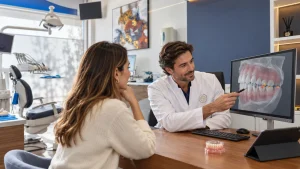
Treatment begins with a detailed clinical assessment. At this stage, the teeth, gums, bite, bone structure, missing teeth and the patient’s expectations are examined.
A Smile Advisor® Consultation It enables us to organise this initial assessment, gather clinical information and understand what the possible treatment options might be for each case.
Depending on the situation, planning may include:
- clinical and functional assessment;
- photographic records and diagnostic tests;
- analysis of the teeth and supporting tissues;
- assessment of the need for implants;
- determining whether a crown, bridge or restoration is required;
- aesthetic and functional planning;
- organisation of the various stages of treatment;
- follow-up and aftercare following the fitting of the prosthesis.
How long does the treatment take?
The duration depends on the complexity of the case.
A crown on a natural tooth may involve a different process to a bridge on implants or a full fixed restoration. Where implants, gum treatments, bone regeneration or healing periods are required, the treatment plan may involve several stages.
In cases where immediate loading is indicated, it may be possible to fit a fixed temporary restoration within a shorter timeframe. However, this depends on the stability of the implants and the clinical conditions encountered.
What steps can you take to help look after a fixed denture?
A fixed prosthesis requires proper oral hygiene and regular check-ups, regardless of whether it is supported by natural teeth or implants.
The main precautions include:
- proper brushing;
- hygiene between teeth, bridges or implants;
- use of the hygiene measures recommended by the clinical team;
- regular maintenance checks;
- checking the health of the gums;
- assessment of signs of wear and tear or overloading;
- use of a night guard where indicated due to bruxism.
Regular check-ups enable changes to be identified at an early stage and help to protect both the denture and the teeth, implants and the tissues that support them.
The first step is to work out which solution is right for you
The choice between a fixed prosthesis supported by natural teeth or by implants should not be based solely on appearance, the duration of treatment or a solution seen in another patient.
It is necessary to understand the current condition of the mouth, which structures can be preserved, what supports are available and what functional and aesthetic outcome can be planned in a responsible manner.
At the Dr Pedro Coelho Clinic in Oeiras, each case involving fixed dentures and oral rehabilitation is assessed on an individual basis, with a focus on function, aesthetics, stability and long-term follow-up.
Book a personalised assessment to understand the options that are right for you.
Fixed dentures supported by natural teeth or implants
What is a fixed denture?
A fixed prosthesis is a restoration that remains in the mouth and is not removed by the patient on a daily basis. It may include crowns, bridges, implant-supported prostheses or complete fixed dentures.
What is the difference between a fixed bridge supported by natural teeth and one supported by implants?
Dentures supported by natural teeth use existing teeth as support. Dentures supported by implants use implants placed in the bone to support crowns, bridges or a more extensive restoration. The choice of treatment depends on the condition of the teeth, gums, bone structure, bite and treatment objectives.
Does the Dr Pedro Coelho Clinic fit removable dentures?
No. The Dr Pedro Coelho Clinic offers fixed solutions for natural teeth and implants, including crowns, bridges and full fixed dentures. The most suitable solution is determined following an individual clinical assessment.
Can all patients have a fixed prosthesis fitted on implants?
Not necessarily. It is necessary to assess general health, the condition of the gums, bone structure, bite and other clinical factors. In some cases, preliminary treatment or a different approach may be required.
Is it possible to carry out a complete fixed restoration?
Yes. The Dr Pedro Coelho Clinic carries out complete fixed restorations on natural teeth or on implants. The type of support, the scope of the treatment and the various stages are determined according to each patient’s clinical condition.
Are All-on-4 and immediate loading available in all cases?
No. All-on-4 and immediate loading may be considered in selected cases, where the clinical conditions and stability are adequate. Only a thorough assessment can confirm whether these approaches are appropriate.
How long does treatment with a fixed prosthesis take?
The duration varies depending on the number of teeth involved, the type of support, the need for implants, the healing periods and the complexity of the restoration. The treatment plan and the estimated duration are explained following the clinical assessment.
Do fixed dentures need maintenance?
Yes. Daily oral hygiene, checking your gums and regular check-ups are important for maintaining your dentures and the structures that support them, whether these are natural teeth or implants.