

When dentures start to make chewing, speaking or feeling confident in everyday life difficult, it is natural for patients to try to adapt. Many people avoid certain foods, chew on one side only, feel self-conscious in public or begin to accept the discomfort as “normal”.
However, the difficulty in chewing with dentures should not be ignored. It may indicate a lack of stability, a poor fit of the dentures, wear and tear, changes to the gums, or the need for a more comprehensive assessment of oral function.
At the Dr Pedro Coelho Clinic in Oeiras, the Oral Rehabilitation It is approached with a focus on diagnosis, comfort, aesthetics and the functional recovery of the smile. Each case must be assessed on an individual basis before any treatment is decided upon.
When a denture starts to get in the way of everyday life
A dental prosthesis should help the patient regain comfort, function and confidence. When it starts to cause a lack of confidence, difficulty eating or frequent discomfort, it ceases to fulfil its purpose fully.
Some patients report that they avoid harder foods, feel their dentures moving, are afraid to smile or speak in public, or need to use strategies to be able to chew more confidently.
These signs can affect more than just eating habits. They can impact self-esteem, social life and a sense of security in everyday life.
Why can chewing be difficult with dentures?
Difficulty chewing can have various causes. In many cases, the mouth changes over time. The gums, the supporting bone, the bite and the fit of the dentures may change, even if the dentures initially felt comfortable.
There may also be wear and tear on the denture itself, a lack of retention, pressure points, an imbalance in chewing, or a lack of sufficient stability when eating certain foods.
It is therefore incorrect to assume that the solution is the same for everyone. In some cases, it may be necessary to adjust the denture. In others, it may be worth considering new options for oral rehabilitation, including fixed solutions or treatments associated with Dental implants, depending, of course, on each patient’s clinical condition.
Signs that you should seek an assessment
You should consider seeking a clinical assessment if you repeatedly experience any of the following symptoms:
- difficulty chewing food that I used to be able to eat;
- a denture that moves when speaking, eating or smiling;
- discomfort, pressure or frequent sores on the gums;
- anxiety about eating out;
- the need to remove the dentures frequently;
- a feeling of instability;
- fear of smiling, speaking or laughing in public;
- questions about alternatives such as fixed dentures or implant-supported restoration.
These signs do not automatically mean that you need complex treatment. They mean that the case should be monitored carefully to understand what is happening and to identify the most appropriate clinical options.
The role of oral rehabilitation
A Oral Rehabilitation in Oeiras It is not simply a matter of “replacing teeth”. It is a field that seeks to restore function, aesthetics, comfort and oral balance.
In cases of tooth loss, unstable dentures or difficulty chewing, the aim is to gain a full understanding of the situation: remaining teeth, gums, bone structure, bite, the aesthetics of the smile, the patient’s expectations and the impact on their daily life.
Based on this assessment, it may be possible to draw up a clearer plan. This plan may involve various approaches, ranging from adjustments and prosthetic solutions to more advanced treatments, always depending on the clinical assessment.
The most important thing is not to make a decision based solely on a general idea or a comparison with other cases. Every smile has its own story and its own circumstances.
Removable dentures, fixed teeth or implants: how do you know which is right for you?
Many patients come to their appointment with a very specific question: “Can I have fixed teeth?” or “Can I have Dental implants ”Are they an option for me?"
The answer depends on a number of factors. It is necessary to assess the patient’s oral health, bone structure, gum condition, bite stability, medical history and expectations.
In some cases, a removable denture may still be an option. In others, it may be worth considering fixed solutions or implant-supported restorations. However, this decision must be based on a diagnosis, careful planning and a clear explanation of the possibilities and limitations.
That is why a personalised assessment is the first step towards understanding what is actually appropriate in each case.
The approach of the Dr Pedro Coelho Clinic in Oeiras
At the Dr Pedro Coelho Clinic, oral rehabilitation is approached with a focus not only on the functional and aesthetic restoration of the smile, but also on the patient’s confidence throughout the process.
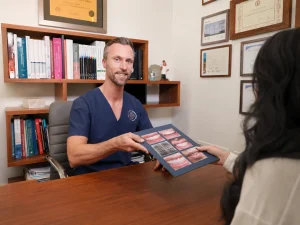
The assessment enables us to understand the problem in greater detail, answer any questions and advise the patient on the available treatment options. This approach is particularly important in cases of tooth loss, uncomfortable dentures, difficulty chewing or feeling self-conscious when smiling.
When the case is more complex, the Smile Advisor® Consultation It can help guide the patient, explain the steps involved and provide a clearer picture before a decision is made.
When should I book an assessment?
If your dentures no longer fit securely, if you find it difficult to chew, or if you’ve lost confidence in smiling, it’s worth getting them checked.
There’s no need to wait until the discomfort becomes severe. The sooner the condition is assessed, the clearer it will be what can be done.
At the Dr Pedro Coelho Clinic in Oeiras, every treatment plan begins with a personalised assessment, taking into account function, aesthetics, comfort and the individual needs of each patient.
Book a personalised assessment and find out what treatment options are available for your condition.
Frequently asked questions about difficulty chewing with dentures
Is it normal to find it difficult to chew with dentures?
Some adjustment may be necessary, especially at first. However, if you experience recurring difficulty chewing, if your dentures move around, or if you experience frequent discomfort, it is important to seek a clinical assessment.
Why might dentures start to cause discomfort over time?
The mouth can change over the years. The gums, the supporting bone, the bite and the fit of the dentures can change, even if the dentures initially felt comfortable. Consequently, dentures that previously worked well may start to cause instability, pressure or difficulty when chewing.
Does a denture that moves always need replacing?
Not always. In some cases, it may be necessary to make adjustments or review the fit of the denture. In others, it may be advisable to consider a new oral rehabilitation solution. The decision always depends on the clinical assessment of each patient.
Are fixed dentures or implants suitable for all patients?
No. Fixed or implant-supported solutions depend on the condition of the mouth, bone structure, general health, bite stability and the patient’s expectations. It is therefore essential to carry out a personalised assessment before making a decision.
When should I seek an assessment?
You should seek an assessment if you find it difficult to chew, if your dentures move when you speak or eat, if you experience frequent discomfort or sores on your gums, if you feel self-conscious when smiling, or if you have any questions about alternatives such as oral rehabilitation, fixed dentures or implants.
Does the assessment help us to work out whether there is a better solution?
Yes. The assessment enables us to understand what is causing the discomfort, analyse masticatory function, assess the stability of the denture and explain the most appropriate clinical options for the case. Each treatment plan must be tailored to the individual.